
Radincon has been supplying ultrasound equipment to vet practices across Australia and New Zealand for years now, and we’ve seen increasing interest in the technology and how to use it. Recently, there’s a strong focus on VPOCUS – veterinary point of care.
We decided it was time to hear from an Australian pioneer of VPOCUS training.
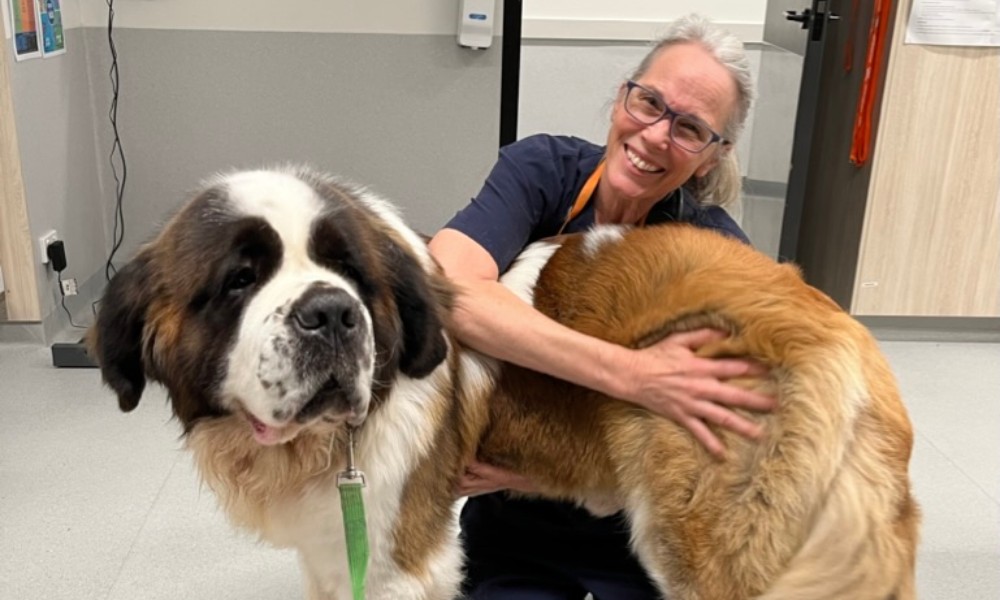
Pamela Manning not only organises workshops through VPOCUS Australia, she also uses it in her own clinical practice. We’ll let her explain.
Tell Us a Little Bit About Yourself
I’m originally from Los Angeles. I came here to study – I’m pretty sure I was the first US vet to train in Sydney. Back then, Sydney University wasn’t accredited, so I had to go back to the US take my exams. I worked for a bit too, but long story short, who’d choose LA over Sydney? I ended up immigrating and here I am.
I worked in general practice for a long time, then in emergency practice at SASH. I also teach clinical skills and communication at Sydney University, and consult to the Centre for Veterinary Education there. And of course I run VPOCUS Australia.
What Led to You Setting Up VPOCUS Australia?
That’s a funny story.
Even when I was a new graduate, vets were using ultrasound. We just had no idea how much it was capable of. Instead it was for equine vets scanning ligaments and doing pregnancy checks, and internal medicine specialists. We would have a go looking at the abdomen in general practice too.
Vets started using ultrasound way back – 30 years ago as I remember – for echocardiograms and abdominal ultrasounds. Then in 2004, there was a landmark paper on bringing the FAST exam to small animals and vets started using ultrasound to look for free fluid. From there the uses continued to grow.
Meanwhile, I was doing some ultrasound in my emergency work. I wasn’t confident. I wanted to know more, but all the training courses were in the States, and they kept booking out. I was frustrated.
I came to realise that other vets were frustrated about missing out on ultrasound training too – and that’s when I had my brilliant idea. I invited Søren Boysen and Serge Chalhoub from the Calgary Veterinary POCUS Training Academy to come and run a course here. Who wouldn’t want a trip to Australia? They said yes!
Nothing’s ever quite that easy, though.
First of all, COVID came along. No one was traveling internationally. So our first events were remote ones. We ran both the online lecture and the hands-on session remotely. For the hands-on session, Soren and Serge set up Go-Pros and FaceTime in Serge’s basement in Calgary and we had Facetime on our phones at our end in Sydney. It’s common now, but it was new then.
Once things were back to normal after Covid, it was time to try the trip to Australia again.
It turned out to be a very popular idea. I ended up with over three hundred bookings, across a total of twelve days. That was four days in Sydney, plus a series of roadshows.
The only problem was finding a venue. My original venue dropped out and I had to find a replacement. At that point, I was the sole organiser. I did everything – the marketing, the certificates, organising the food, booking hotels and so on. But the venues were really confused because I was a single individual. They expected an organisation. It was easier to give them one.
So, VPOCUS Australia was born!
Now we have Søren and Serge come out every year. Sometimes they divide up and come out twice a year.
We run the main courses that we promote on our website, but we also offer private training sessions. When Søren and Serge are in town, we run courses with them; otherwise, we work with our other POCUS experts. Also, we run sessions at the practice’s own premises.
Tell Us More About VPOCUS: the Approach and When to Use It
The first thing to be clear about is that we specialise in point of care ultrasound, and the approach is quite different from that of the classic complete abdominal ultrasound scan.
We assess three main areas: the heart, the thorax, and the abdomen. Within those, we can ask more than 20 binary questions that help us manage the patient.
The aim is to narrow our diagnostic options quickly and efficiently, and we can also use ultrasound to guide procedures when we need to.
No surprise, I’m a big fan and believe every vet should learn VPOCUS, because it’s so useful in so many ways.
There’s a misconception that POCUS is mainly useful for emergencies. Yes, we absolutely use it in emergency practice – but it’s just as useful in everyday practice.
We’ve started integrating it throughout the day, not just when a patient comes in sick. POCUS has become an important part of how we assess and manage our patients.
So, let’s look at some examples
Triage
At the triage bench, for example in a collapsed dog, I will take the history and triage exam into consideration, then look to scan the most likely useful window. For example in a collapsed dog, I can rule in or out a haemoabdomen quickly. Or in a dyspnoeic cat, I can tell if asthma or congestive heart heart failure is more likely, then treat accordingly.
Trauma
For trauma, if the patient is dyspnoeic, we’re looking for things like pneumothorax, haemothorax or pulmonary contusions – problems which may need to be treated quickly. We can also look for free fluid in the abdomen; for example, bleeding following trauma.
Hospital Patients
For hospital patients, we look at the lungs, the subjective contractility of the heart, and the vessel size of the caudal vena cava. Combining these results lets us estimate hydration levels, so we can adjust how much fluid we give.
We also monitor and track over time. For example, when we have a dog in hospital for congestive heart failure, we can treat the patient and track over time to see how it’s responding.
Total Systemic Evaluation
Every morning I fully evaluate my patients physically, then do a point-of-care systemic evaluation, checking everything, even when a patient is stable
I can’t tell you the number of times I’ve picked up pulmonary metastasis on a hospital patient where there’s been no respiratory signs, so no thoracic workup. It’s not a pleasant thing to find, but at least it gives owners knowledge, and more information from which to make decisions on care.
Ticks and Other Cases with Risk of Aspiration
This is so important here in Australia where the paralysis tick is so common. Our aim is to treat aspiration as early as possible, or even prevent it happening at all.
If you’ve got a tick case in hospital, it takes less than a minute a day to check the chest and pick up aspiration.
One more amazing thing: it can be easier to pick up aspiration early via VPOCUS than by x-ray. Ultrasound picks up more subtle signs, plus there’s no interference from the heart, which can be in the way on x-rays.
Pericardial Effusions
POCUS is a fantastic way to identify pericardial effusion – and even beyond that, to identify the specific kind of effusion.
I remember one little dachshund came in looking kind of wonky. He was about to be sent to neurology for a workup, but I popped the probe on and did a quick scan. One spot lit up like a Christmas tree — pericardial effusion. We could also tell that it was a right atrial tear, so tapping wasn’t an option.
I love that story because it shows how we could diagnose quickly and stabilise the patient in the best way for their condition – without other extensive workups and delay. So often patients come in close to dying and you don’t have much time. POCUS gives you more time.
So Why Isn’t VPOCUS Used More Widely?
There’s a few overlapping reasons.
Training and Confidence
There’s huge interest in VPOCUS and in ultrasound generally. You can tell that from the number of training courses on offer from everyone, not just us, and the way they book out.
But rolling out the training is challenging. Even if all new vets (or all new human doctors, for that matter) receive training, the vast majority of practices don’t necessarily get a new person right away.
The universities are starting to build ultrasound into their veterinary courses, but that’s only happening just now.
There’s also the issue of traditional comprehensive ultrasound vs the VPOCUS binary model. Vets may be trained on one model and not the other. Some may not even know that two different approaches exist.
The capabilities of ultrasound and the ways we use it are evolving, which makes it hard for training to keep up. Vets have to learn so many different skills and techniques.
One example is ultrasound for heart and lungs. It’s actually pretty easy to learn, but if you’ve never been taught where to put the probe, you’re not likely to use ultrasound for heart and lungs.
Equipment and Clinic Workflows
Most practices have equipment, but that doesn’t mean they automatically use ultrasound at point of care.
Sometimes the equipment just isn’t ready and available. I heard of one case where the valuable ultrasound machine was kept locked away, so unless you were the vet with the key, it was a hassle to use it. Fortunately that one is now past history!
But the underlying clinical thinking – asking the question ‘would ultrasound help here?’ – is harder to change, especially when vets have been in practice for years. Younger vets with newer training are still learning how to run a clinic, plus they have less authority, so sometimes the approach is slow to change.
Then there’s the question of older equipment. You can use it, but the results from the newer models are so much better. Clearer images, more detail. Not just a pitch for Radincon, it’s the truth!
Another one from left field is that I’ve heard vets say they don’t know how to charge for the ultrasound. These are the kind of process issues which can hold up adoption.
Any Final Recommendations for Vets on How to Get More from Their Ultrasound Equipment and Training?
Keep learning!
There’s so much development happening in ultrasound all the time. You might think you’re trained and up to date, but it won’t stay that way.
Keep practising!
It’s one thing to do training, even hands-on training, but when you go back to your practice, you need practice – about 20 scans in the first month as a start. There’s a thing called skill-fade which is highest in the first 1-3 months following learning a new skill. If you don’t practise, you’ll lose the value of your training and you won’t be able to help your patients.
We’re actually trialling an ongoing support program for the period after our workshops right now. That’s how important we think this is.