
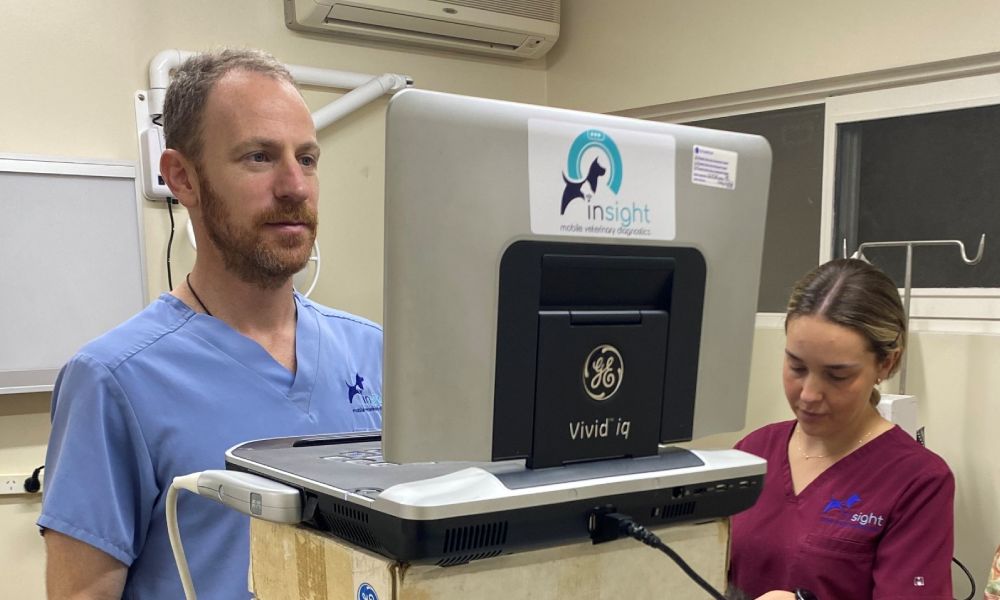
Clint Yudelman of Insight Mobile Veterinary Diagnostics has been part of the Radincon extended network for years now. (In fact, he’s a second-generation client – we also supplied GE ultrasound equipment to his father.) We caught up with him to learn a little more about the life of a mobile vet.
How long have you been a vet?
I qualified as a vet 16 years ago. I had dreamed of being a sports doctor, but I didn’t get into medicine. Looking back, that was a blessing in disguise. I couldn’t be happier with how things worked out in the end – becoming a small animal medicine specialist.
Tell us about becoming a mobile vet
I found out very early on that my real passion is internal medicine which relies heavily on diagnostic imaging. This career path allows me to do more of that, instead of general veterinary day-to-day treatment. With more imaging, I’m also more experienced and up to date with the latest knowledge, so it’s a better result for the patients too.
When I first started Insight Mobile Veterinary Diagnostics there were only a handful of mobile imaging providers in Melbourne. Since then, the number of providers has probably doubled.
Insight Mobile Veterinary Diagnostics stands out compared to most other mobile imaging providers in two ways: we have an internal medicine spin and we offer specialist oversight and input. We don’t just do a scan and leave it to the primary care vet to work out what to do. We do the imaging and then provide guidance on case management moving forward.
How big is your practice?
When I started out, it was just me. I was everything from the vet to the receptionist. But the model’s been very successful. I’m now one of 5 vets in the practice, supported by 6 or 7 nurses and multiple receptionists. The total numbers ebb and flow a little, but overall we’re growing.
The practice has Australia’s first (and so far only) mobile CT unit. Apart from that, our focus is ultrasound and endoscopy with the bulk of the work being ultrasound.
We have adopted a similar philosophy to the human medical imaging model whereby our skilled veterinary sonographers do a lot of our scans but to ensure specialist input I review all the images and write the final report. That way we can get out to more patients but still keep our point of difference, which is specialist oversight and input in every case.
What equipment do you use?
We have three GE Vivid iq ultrasound units in the practice. I’ve used a Vivid right from the start. For a mobile vet like me:
- It’s compact and easily transportable.
- It starts up and turns off quickly, in just a couple of minutes. When you’re visiting 8-10 practices in a day, that’s important.
- It’s user-friendly and robust.
In addition, the back-end support is fantastic. Recently I wanted to add some species-specific calculations we use for cat and dog echocardiograms. That kind of requirement is uniquely for the vet industry rather than human medicine, and I wasn’t sure it would be possible, but the GE technician had it set up in no time.
Radincon are equally supportive. I took on a new vet recently, and I didn’t want to commit to a new ultrasound unit till I knew that vet would work out. The Radincon team leased me an ex-demo model for a period to reduce that risk. Plus a few years back, when my car was stolen with my Vivid in the back, they found a machine for me to lease within a day. When you’re a small business, it’s great to have partners on your side, finding ways to make things work.
The technology has improved over the years I’ve been a vet. Image quality has improved, and of course we use cloud technology to share images and diagnose promptly.
What kind of animals do you treat?
The vast majority of our patients are cats and dogs. I also have an ongoing relationship with Zoos Victoria, which means a lot of variety! We’ve conducted ultrasounds for gorillas, penguins, monkey and more. Most recently we performed a reproductive ultrasound on a Sumatran tiger.
From the Zoo’s perspective, anaesthetising a wild animal is a major project already, so it makes sense to get specialist ultrasound support at the same time. All the same, we’re very glad to have the zoo vets on hand and consult with them. They deal with unique species all the time, which we don’t. Combining our different expertise means two heads really are better than one.
What are your plans for the future?
I’d love to carry on doing what I do now – that’s why I chose this path in the first place!
My aim is to be known as delivering high quality service and accurate diagnosis, reliably time after time. I love working in ongoing partnerships with local practices, suppliers and others.
Do you have any advice for vets who are starting out?
One thing I’ve noticed over the years is that new vets seem less willing to take on a challenge and to trust their own judgment. I’m not sure why this is. Perhaps there’s more fear of litigation if you make a mistake, or they are trained in this way.
It’s easy to refer tricky cases to a more senior vet, but it doesn’t help you grow or build your confidence. My advice to younger vets would be to trust yourself and your judgment, and to take on challenges rather than getting stuck in a rut.