
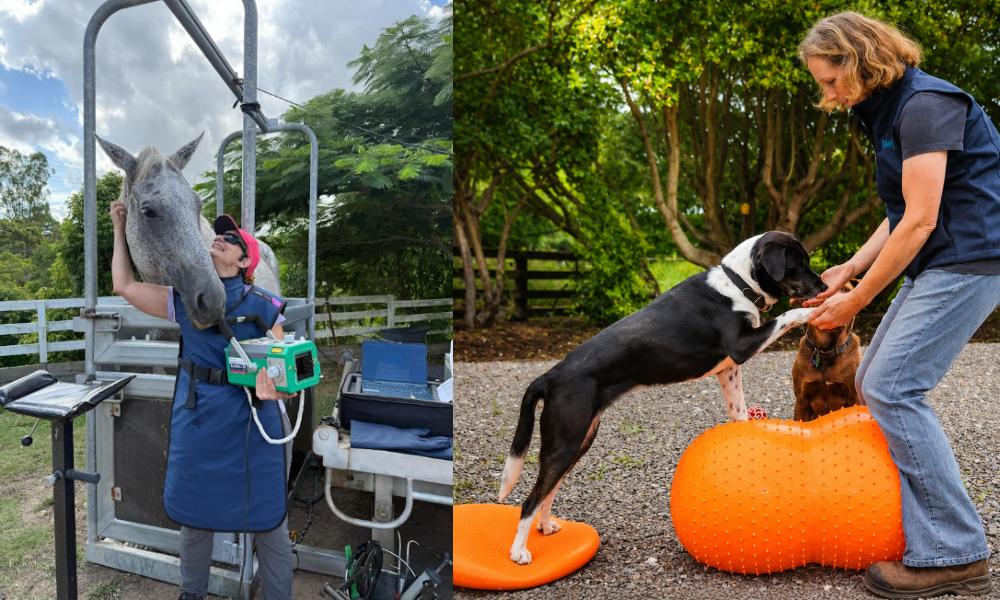
Veterinary AI is moving rapidly from conference presentations and technology demonstrations into everyday clinical work. But what does useful, responsible AI actually look like inside a veterinary practice?
We spoke with two veterinarians, one in Australia and one in New Zealand, who are already using AI to improve documentation, client education, route planning and rehabilitation support.
Introducing Our Vets
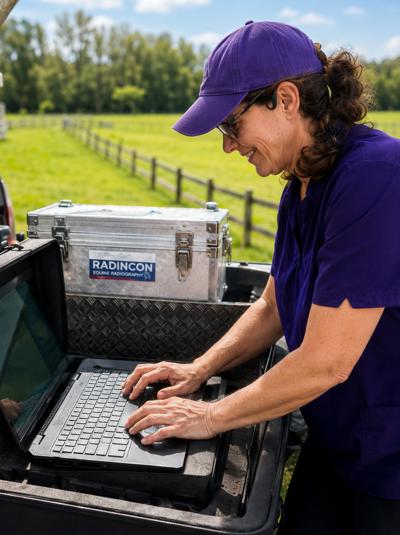
Dr Shaan Mocke
Shaan runs Vet Align, a mobile veterinary practice in South East Queensland, treating horses and small animals. She has been using Radincon equipment since her time at WestVETS Animal Hospital.
In her words:
“I don’t like making do. When I needed an X-ray unit, I compared several options, but Radincon consistently stood out for image quality, performance and service. I also value how much the company gives back to the veterinary community. I love my Rover because it produces consistently high-quality images, which supports better diagnostic decision-making.”
That relationship is how we got in touch with Shaan and heard about the ways she has been using AI in her work.
Shaan holds Membership of the Australian and New Zealand College of Veterinary Scientists in Equine Dentistry. Her current work focuses primarily on veterinary rehabilitation, biomechanical medicine, acupuncture and therapeutic laser treatment for horses and small animals.
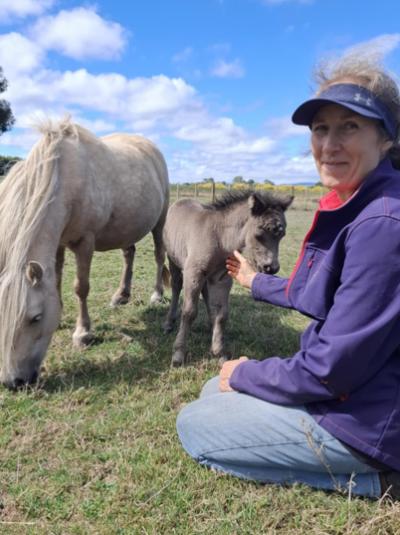
Dr Deb Prattley
Deb runs VetRehab, a practice based in the Manawatu region of New Zealand. She is a rehabilitation veterinarian and chairperson of the newly established NZVA Veterinary Rehabilitation Network. She is also qualified as a human osteopath, so she treats not only horses, ruminants and small animals, but people too. Her toolkit also includes physical therapies, chiropractic, acupuncture and saddle fitting.
***
The two have more in common than their veterinary interests:
– neither went straight from school into veterinary study
– both studied at Massey University
– both worked with IT at different times.
Deb worked as a farm hand for a few years before vet school, and while at Massey had a summer job she loved developing computer-aided learning tools for veterinary education. Later, she completed a Masters in Bioinformatics at Glasgow University.
Shaan studied computer programming, then spent a decade as a web applications analyst at a top-tier law firm in Auckland, New Zealand. She was also building websites from the early 2000s.
There is also a longer personal connection. Deb was the rehab vet Shaan trusted to treat her own horses before she herself qualified. Deb was also the first person Shaan spoke to about her realisatoin that she wanted to become a vet, and Deb encouraged her. Age is not a barrier!
Given all that shared history, including their interest in technology, no wonder they ended up collaborating on how AI might help vets work better.
How They Got Started
Deb
“It started with my summer job at Massey,” Deb says.
“We were trying to minimise the use of animals in training vets, part of a programme called CALVE (Computer-Aided Learning in Veterinary Education). The field has advanced hugely now, but back then I was using Photoshop and HyperCard, developing creative and interactive ways to make learning fun and memorable.
“One example was that a student could click on a syringe on screen and ‘inject’ a medication, and the system would show the effects. It might darken the part of the leg numbed by a nerve block, for instance.
“It was very simple compared with what we can do now, but the idea was the same, how can technology help make learning more impactful, while sparing the use of animals?”
Shaan
“I began experimenting seriously with ChatGPT in 2023,” Shaan says. “At that stage, it still felt limited because its knowledge was not always current, but I could see where the technology was heading and how useful it might eventually become.”
“I was at WestVETS at the time, and I spoke to one of the partners about using AI to improve consultation notes. That probably came from my law firm days. Lawyers are meticulous about documentation being accurate and complete, and they use carefully crafted templates. Our veterinary notes are just as important. They support continuity of patient care, and they are also legal documents.
“I’ve always been slow at writing notes, so the opportunity to get help with AI was obvious, especially after a busy day. Leaving work on time, with everything done, feels good. It gives you more time for family, friends and your own life outside work.”
How AI Can Save Time and Improve Results in Practice
For Shaan and Deb, the most useful AI tools aren’t about replacing clinical judgement. They’re about reducing repetitive work, improving communication and creating more time for the parts of the job that need a vet’s attention.
Here are some of the areas they have explored and found value.
Note-Taking and Records
Good AI-assisted note-taking requires proper setup. Templates are helpful, but need clear instructions and guardrails.
You might tell an AI tool that a heart rate was “normal” but not give an actual number. Be clear that it can’t fill in a heart rate from general knowledge. That would create an inaccurate medical record.
“I tell mine it must only report what I actually give it,” Shaan says. “Nothing inferred from external data.”
Human oversight is still essential. Every note needs to be checked.
Once the process is set up, AI can turn notes from one consultation into multiple useful formats, such as:
- Full clinical notes for the medical record and for any colleague who may see the patient later
- Abbreviated referral notes focused on one issue rather than the whole case
- Client summaries with appropriate client-friendly terminology
That last format is especially useful in rehabilitation. Clients don’t understand language like “massage the brachiocephalicus muscle”. They need clear, easy instructions, such as “gently massage the side of the neck”. AI can alter the language used to create the specific outputs you need.
Scheduling Visits
Both Shaan and Deb are mobile vets, so travel is part of the job. Planning routes can be complicated. There are appointment windows, client availability, distances, time constraints and travel time to consider. Without admin support, it takes up vet time.
They used AI-assisted coding tools to develop a route-planning app for their own mobile vet work. The user enters the visits, addresses and any constraints, such as the likely duration of each visit or client availability. The app then works out a practical route for the day.
There’s also a fuel-saver function, useful when fuel costs are high!
The result? Less time spent on admin, more efficient travel routes and, sometimes, more time to recharge.
This project also demonstrates how much faster basic software prototyping has become. Deb created the initial documentation outlining the idea and features, then Shaan built the app and took it live – all in one afternoon. In the past, similar small internal tool would have taken months to develop.
Client Support Apps
Shaan and Deb are building a client support app for dogs recovering from cruciate ligament surgery. They’ve already run it through a beta tester.
For dog owners, the post-operative period can be stressful. They’re used to a dog which runs around freely, and suddenly they may be managing a bandage, crate rest, medication, toilet monitoring and rehab exercises – all alongside their normal daily responsibilities.
The app helps clients understand:
- What to expect during recovery
- What is normal
- Which signs may indicate a complication
- When to contact the clinic
- How to perform common exercises correctly
Videos of common rehabilitation exercises mean clients can check what they’re doing at home. If unusual symptoms come up, those can be flagged back to the clinic. The veterinary team can assess them and decide whether action is needed.
To help keep the clinical content specific and evidence-informed, Shaan and Deb used NotebookLM, an AI research tool designed to ground its responses in sources selected by the user. They uploaded relevant research papers, reviewed the source material carefully and checked the generated outputs before including them in the app.
“We wanted to be careful about the quality of the source material,” Shaan says. “The tool is only as useful as the information you give it.”
This may be one of the more practical uses of veterinary AI. It doesn’t replace the vet’s advice, but turns it into something clients can understand, revisit and follow at home.
Shaan and Deb expect to see more personal software being developed over time. With AI coding tools, small teams can now prototype simple internal apps for very specific problems in their own practice.
Keeping Your Own Knowledge Current
AI can also help vets keep up with new information.
One option is set up tools so that they monitor specific topics, journals or clinical areas and flag new research. AI can help summarise studies, extract key findings and prompt questions about methodology or limitations.
However, the veterinarian still needs to read the original paper and assess its quality and clinical relevance.
Tips for Implementing Veterinary AI
The pattern emerging internationally is not blind enthusiasm. Most vets seem interested in AI where it saves time or reduces admin, but many remain cautious.
Shaan and Deb believe three principles need to be built into any AI use in veterinary practice. They apply whether a clinic has developed a tool itself or is using AI features already bundled into practice management software, such as transcription.
The three principles are: be honest with your clients, keep a human in the loop, and build AI literacy across the team.
Be Honest with Your Clients
If you’re using AI, say so. Explain how.
That might mean a notice in your practice, a note or consent box on patient forms, or a short explanation when using AI-assisted transcription or documentation tools.
Even if the only AI you use is built into your practice software, being upfront is better for client relationships. Eventually it will become the norm, like taking patient photos for social media. But clients need to be given the choice.
It’s also worth having an AI ethics policy. It doesn’t have to be long, but it should cover:
- What you use AI for
- What you do not use AI for
- How you manage data and protect privacy
- Who is responsible for checking AI-generated material
- How you make sure the AI is working as intended
Keep a Human in the Loop
Modern AI is capable enough that it’s easy to start trusting it too much.
Think of it like a highly educated research assistant who has read everything but never actually picked up a stethoscope and listened to a dog’s heart. It knows the theory, but it hasn’t met your patient. Everything still needs human review, every time.
Build AI Literacy Across the Team
The third principle is AI literacy.
AI is only useful if people understand how to use it well. Without that understanding, staff may avoid it completely, trust it too much, or use it in ways that create extra work instead of saving time.
That’s one reason Shaan and Deb have started offering small, purpose-built AI literacy sessions for veterinary teams, especially those in small or solo businesses. These sessions are designed around the realities of veterinary practice, rather than generic business examples.
The focus is practical, explaining how AI works and including how to use AI for clinical notes, client summaries, education resources, internal systems and everyday workflow, while still protecting privacy and keeping veterinary judgement at the centre.
AI literacy also means understanding the limitations. Teams need to know when AI is useful, when to avoid it, and what information it should and shouldn’t be given.
Where Veterinary AI Seems to Be Heading
Veterinary AI is still evolving, but its most valuable role may be relatively simple: reducing repetitive work, making information easier to understand and giving veterinary professionals more time for the tasks that require human judgement, empathy and clinical skill.
AI-assisted interpretation is also developing rapidly in veterinary radiology. However, independent studies show that performance varies by condition and body region, so these systems should currently be treated as second readers rather than substitutes for veterinary radiologists or clinical judgement. Good positioning, appropriate views and high-quality image acquisition remain essential.
The challenge is not simply to adopt AI, but to use it deliberately, transparently and safely. When veterinary teams remain accountable for every output, AI can support better workflows without displacing the expertise and relationships at the heart of veterinary care.
A big thank you to Shaan and Deb for sharing their experience.